




Does leaving your homeland also mean the loss of safety and orientation? Who are we in between places? When giving up on the emotional connection to one place, do we also lose a part of our identification? Is there the possibility of a second or even a third homeland?
Travelling enriches us, visiting foreign countries inspires us, learning about different cultures broadens our horizon and helps us taking up new perspectives. But, do we find the same grade of accomplishment, when leaving one home for another?
Having emigrated from the Ukraine to Germany almost 12 years ago, Maryna Markova describes herself as being somewhere in a process of adjusting. Between a vague understanding for her environment and somehow adopted ideas about herself, this very day she still feels in search for some certain identification, still looking for a sense of belonging. As a teenager there had been no other option, but to follow her family into that new, that unknown world and that is how Maryna Markova arrived, filled up with ideas and fantasies, about how her German life is going to develop. But leaving a place and relocating to another country very often comes with irritation. You’ll have expectation and of course, what you will find is very different from what you have hoped to find. “(Dis)embeddedness” to Maryna Markova, specifies exactly what happens throughout an irreversible process of change and transformation. Vital to this process of adapted manners and the actual need to hold on to familiar routines, is a growing fear to lose any spiritual accommodation and the sense for places. “Besides the effort to emotionally survive, my memories started getting mixed up. Almost like distant stories I would hear of another person, the outlines of my perspective and the people’s opinion about myself, seemed to fade like a forgotten dream. And suddenly, one day it hit me. It became clear to me; this was no longer a question about who I am. This wasn’t about were I stood, indecisive between my old and my new home. I simply had to accept that within all that assimilation and the changes, I already become someone else. Someone I did barely know.“
Annton Beate Schmidt / here and now…amnesia / Katalog, 2011
Amnesie
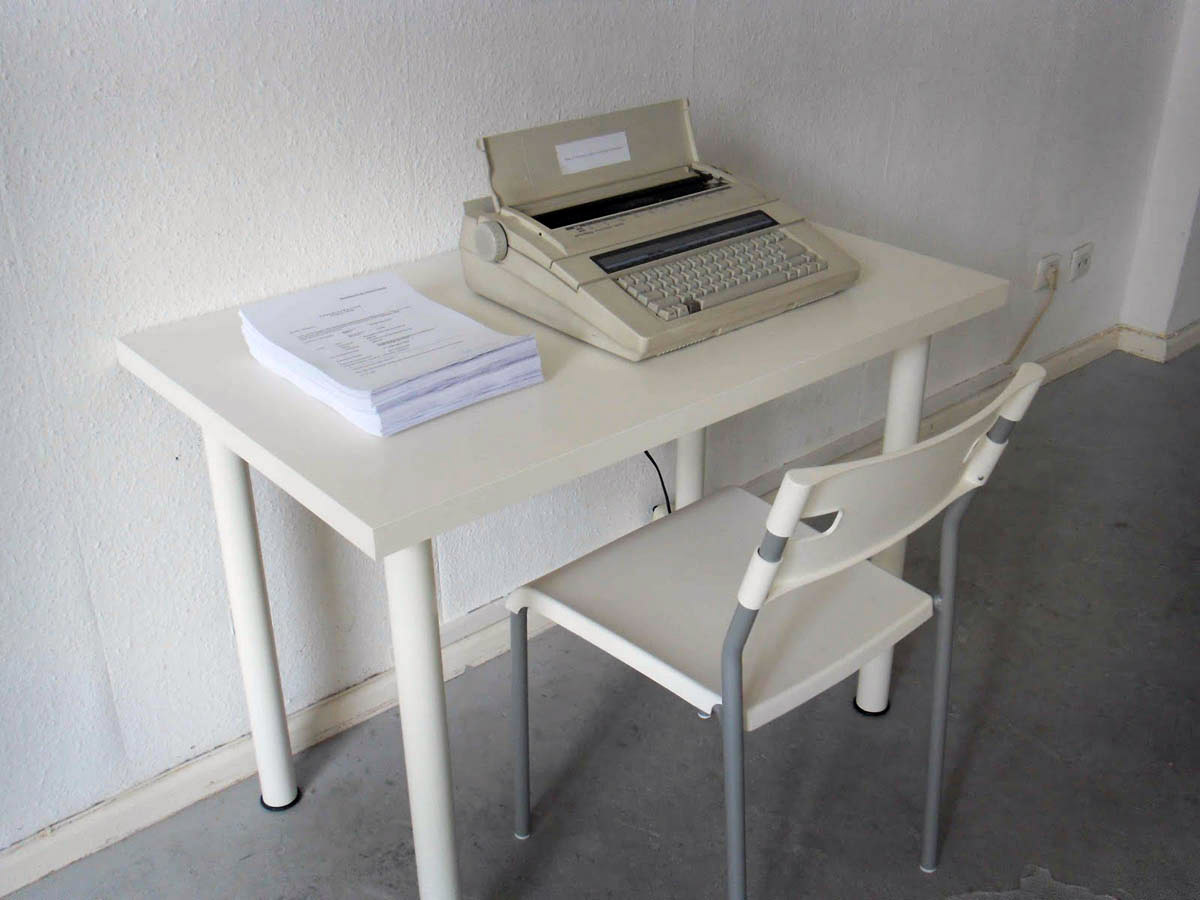
A table,
an old typewriter and
a pile of documents.
Born August 22nd, 1983. In fact, uncounted copies of the birth certificate Nr. 499122. Though we find the names of a mother and a father, a birth place and a note saying “Jewish”, there is no hint about the person behind. It could be anybody writing their name into the blank space, putting on another identity like a stranger’s coat. Or it might be the result of someone having lost parts of their inner homeland, in search for an outside reminder.
Annton Beate Schmidt / here and now… amnesia / Katalog, 2011